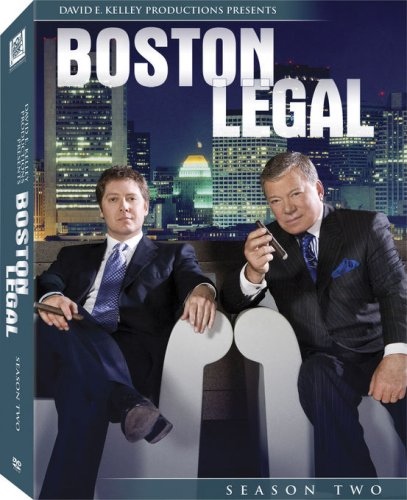
Director: Boston Legal
Starring: Boston Legal
Genre: Television
Studio: Twentieth Century Fox Theatrical: 2004 Rated:
G
Languages (Country): English ()
Summary: Impressive in quality "and" quantity, the 27 episodes of "Boston Legal"'s second season (2005-06) are a dazzling showcase for one of TV's greatest ensembles. Everything that made season 1 so entertaining is refined here, often to the point of perfection: As the resident bad boys of the prestigious Boston legal firm of Crane, Poole & Schmidt, senior partner Denny Crane (William Shatner) and maverick attorney Alan Shore (James Spader) continue their campaign of rampant indiscretion, combining unabashed sexism and political incorrectness with Denny's egotistical fat-cat sense of entitlement (and a touch of "Mad Cow") and Alan's passion for justice and courtroom theatrics. The departure of his girlfriend Tara (season 1's Rhona Mitra) has left Alan pensively lonely, so his male-bonding with Denny becomes the series' emotional core, even as it reaches new heights of hilarity in episodes like "Finding Nimmo," an instant classic in which Denny introduces Alan to the pleasures of fly-fishing. Back at the office, semi-regular cast member Betty White turns from murder to robbery, only to find herself redeemed as the new "sandwich lady" at C, P & S. And while senior partner Paul Lewiston (Rene Auberjonois) juggles the firm's ethical dilemmas and a rocky reunion with his drug-addicted daughter (superbly played by Jayne Brook), founding partner Shirley Schmidt (Candice Bergen) dodges advances from her soon-to-be-remarried ex-husband (Tom Selleck) while suspecting Denny's soon-to-be-sixth-wife (Joanna Cassidy) of high-stakes gold-digging. In the midst of it all, Denise (Julie Bowen) faces threatening competition from a new attorney (Parker Posey) and elusive love with a dying billionaire (Michael J. Fox) while playing "friends with benefits" with colleague Brad (Mark Valley), who's only too willing to indulge their arrangement.
Expanded roles for Bowen and Valley are just two of this season's welcome improvements; along with Bergen and Auberjonois, they add engaging counterbalance to the Spader/Shatner juggernaut, while newcomers Justin Mentell and Ryan Michelle Bathe (as legal assistants) add youthful appeal in roles that necessarily remained marginal for most of the season. As always, series creator David E. Kelley (aided by a new writing staff) maintains a constant flow of outrageous behavior (most of it Denny's) and compelling courtroom trials based on hot-button issues including assisted suicide, the war in Iraq, private school discrimination, medical malpractice, tax evasion and a variety of other cases in which belligerent judges (played by Henry Gibson, Anthony Heald, Howard Hesseman, Shelley Berman, and others) play antagonistic foils to Alan Shore's impassioned defense. (It's here where Spader excels; Shore may be a lascivious lothario, but you offend his moral conscience at your peril.) A stellar array of guest stars, impeccable editing and cinematography, and glossy office production design make "Boston Legal" a constant feast for the eyes and ears, with breezy emphasis on the farcical goings-on at Crane, Poole & Schmidt. (The series' writing and production values are explored in brief but enjoyable bonus featurettes included on the final DVD in this seven-disc set.)
With Denny and Alan's season-ending visit to Los Angeles (where they defend a sexy celebrity played by "Star Trek: Voyager"'s Jeri Ryan), it's delightfully obvious that Shatner and Spader are the heart and soul of "Boston Legal", which is ultimately about the mutual affection of two men whose viewpoints are often as polarized as their friendship is compassionately co-dependent. Bolstered by clever allusions to Shatner's "Star Trek" legacy and throwaway references to their own status as characters in a TV show (as Kelley and his writers deliberately demolish the "fourth wall" of TV for comedic effect), Spader and Shatner quickly turned their episode-closing balcony scenes into an honorable tradition, where differences dissolve in the taste of fine scotch and slowly-savored cigars. They're bringing us the finest "dramedy" that primetime network television has to offer, and we'll gladly follow them as their crazy lives continue. "--Jeff Shannon"

Director: A. Coulter, J. Patterson Tim v. Patten
Starring: James Gandolfini, Edie Falco, Michael Imperioli, Tony Sirico, Steve van Zandt
Genre: Television
Studio: HBO Home Video Theatrical: 2004 Rated:
NR
Languages (Country): English, Spanish, French ()
Summary: Facing an indeterminate sentence of weeks/months/years until new episodes, fans of "The Sopranos" are advised to take the fifth; season, that is. At this point, superlatives don't do "The Sopranos" justice, but justice was at last served to this benchmark series.
James Gandolfini as Tony Soprano in a not-so-nice mood For the first time, "The Sopranos" rubbed out "The West Wing" to take home its first Emmy® for Outstanding Dramatic Series. Michael Imperioli and Drea de Matteo also earned Best Supporting Actor and Actress honors for some of their finest hours as Christopher and Adriana. From the moment a wayward bear lumbers into the Sopranos' yard in the season opener, it is clear that "The Sopranos" is in anything but a "stagmire." The series benefits from an infusion of new blood, the so-called "Class of 2004," imprisoned "family" members freshly released from jail. Most notable among these is Tony's cousin, Tony Blundetto (Steve Buscemi, who directed the pivotal season three episode "Pine Barrens"! ), who initially wants to go straight, but proves himself to be something of a "free agent," setting up a climactic stand-off between Tony and New York boss Johnny Sack.
Carmela and Tony These 13 mostly riveting episodes unfold with a page-turning intensity with many rich subplots. Estranged couple Tony and Carmela (the incomparable James Gandolfini and Edie Falco) work toward a reconciliation (greased by Tony's purchase of a $600,000 piece of property for Carmela to develop). The Feds lean harder on an increasingly stressed-out and distraught Adriana to "snitch" with inevitable results. This season's hot-button episode is "The Test Dream," in which Tony is visited by some of the series' dear, and not-so-dearly, departed in a harrowing nightmare. With this set, fans can enjoy marathon viewings of an especially satisfying season, but considering the long wait ahead for season six, best to take Tony's advice to his son, who, at one point, gulps down a champagne toast. "Slow down," Tony says. "You're supposed to savor it." "--Donald Liebenson "
Explore More
For an even deeper immersion into the world of crime (movies, that is) see our guides to crime classics and our who's who compendium of famous mob bosses.
Bada Bing! More of "The Sopranos" at Amazon.com
"The Complete First Season"
"The Complete Second Season"
"The Complete Third Season"
"The Complete Fourth Season"
Seasons 1-5
"The Sopranos Family Cookbook"

Director: Dominic Chianese, Allen Coulter Tim Van Patten
Starring: James Gandolfini, Edie Falco, Michael Imperioli, Tony Sirico, Steve van Zandt
Genre: Television
Studio: HBO Home Video Theatrical: 2002 Rated:
NR
Languages (Country): English, Spanish, French ()
Summary: Carmela to Tony: "Everything comes to an end." True enough, Mrs. Sope, but on "The Sopranos", the end comes sooner for some than others. Though for some the widely debated fourth season contained too much yakking instead of whacking, and an emphasis on domestic family over business Family, what critic James Agee once said of the Marx Brothers applies to "The Sopranos": "The worst thing they might ever make would be better worth seeing than most other things I can think of." And in most respects, "The Sopranos" remains television's gold standard. The fourth season garnered 13 Emmy nominations, and subsequent best actor and actress wins for James Gandolfini and Edie Falco as Tony and Carmela, whose estrangement provides the season with its most powerful drama, as well as a win for Joe Pantoliano's psychopath Ralph. The season finale, "Whitecaps," was a long-time-coming episode, in which Carmela at last stands up to "toxic" Tony, and "Whoever Did This" was the season's--and one of the series'--most shocking episodes.
Other narrative threads include Christopher's (Emmy nominee Michael Imperioli) descent into heroin addiction, Uncle Junior's (Dominic Chianese) trial, an unrequited and potentially fatal attraction between Carmela and Tony's driver Furio, and a rude joke about Johnny Sack's wife that has potentially fatal implications. Other indelible moments include Christopher's girlfriend Adriana's projectile reaction to discovering that her new best friend is an undercover FBI agent in the episode "No Show," Janice giving Ralph a shove out of their relationship in "Christopher," and the classic "Quasimodo/Nostradamus" exchange in the season-opener, which garnered HBO's highest ratings to date. Freed from the understandably high expectations for the fourth season, heightened by the 16-month hiatus, these episodes can be better appreciated on their own considerable merits. They are pivotal chapters in television's most novel saga. "--Donald Liebenson"

Director: Allen Coulter Tim Van Patten
Starring: James Gandolfini, Edie Falco, Dominic Chianese, Nancy Marchand, Michael Imperioli
Genre: Television
Studio: HBO Home Video Theatrical: 1999 Rated:
NR
Languages (Country): English, Spanish ()
Summary: "The Sopranos", writer-producer-director David Chase's extraordinary television series, is nominally an urban gangster drama, but its true impact strikes closer to home: Like 1999's other screen touchstone, "American Beauty", the HBO series chronicles a dysfunctional, suburban American family in bold relief. And for protagonist Tony Soprano, there's the added complexity posed by heading twin families, his collegial mob clan and his own, nouveau riche brood.
The series' brilliant first season is built around what Tony learns when, whipsawed between those two worlds, he finds himself plunged into depression and seeks psychotherapy--a gesture at odds with his midlevel capo's machismo, yet instantly recognizable as a modern emotional test. With analysis built into the very spine of the show's elaborate episodic structure, creator Chase and his formidable corps of directors, writers, and actors weave an unpredictable series of parallel and intersecting plot arcs that twist from tragedy to farce to social realism. While creating for a smaller screen, they enjoy a far larger canvas than a single movie would afford, and the results, like the very best episodic television, attain a richness and scope far closer to a novel than movies normally get.
Unlike Francis Coppola's operatic dramatization of Mario Puzo's "Godfather" epic, "The Sopranos" sustains a poignant, even mundane intimacy in its focus on Tony, brought to vivid life by James Gandolfini's mercurial performance. Alternately seductive, exasperated, fearful, and murderous, Gandolfini is utterly convincing even when executing brutal shifts between domestic comedy and dramatic violence. Both he and the superb team of Italian-American actors recruited as his loyal (and, sometimes, not-so-loyal) henchmen and their various "associates" make this mob as credible as the evocative Bronx and New Jersey locations where the episodes were filmed.
The first season's other life force is Livia Soprano, Tony's monstrous, meddlesome mother. As Livia, the late Nancy Marchand eclipses her long career of patrician performances to create an indelibly earthy, calculating matriarch who shakes up both families; Livia also serves as foil and rival to Tony's loyal, usually level-headed wife, Carmela (Edie Falco). Lorraine Bracco makes Tony's therapist, Dr. Melfi, a convincing confidante, by turns "professional," perceptive, and sexy; the duo's therapeutic relationship is also depicted with uncommon accuracy. Such grace notes only enrich what's not merely an aesthetic high point for commercial television, but an absorbing film masterwork that deepens with subsequent screenings. "--Sam Sutherland"

Director: Allen Coulter, Tim Van Patten
Starring: James Gandolfini, Edie Falco, Dominic Chianese, Nancy Marchand, Michael Imperioli
Genre: Television
Studio: HBO Home Video Theatrical: 2000 Rated:
NR
Languages (Country): English, Spanish ()
Summary: In its second season, "The Sopranos" sustains the edgy intelligence and unpredictable, genre-warping narrative momentum that made this modern mob saga the most critically acclaimed series of the late 1990s. Creator-producer David Chase repeatedly defies formula to let the narrative turn as a direct consequence of the characters' behavior, letting everyone in this rogue's gallery of Mafiosi, friends, and family evolve and deepen.
That gamble is most apparent in the rupture of the relationship that formed the spine of the first season, the tangled ties between capo Tony Soprano (James Gandolfini) and monstrous matriarch Livia (Nancy Marchand), whose betrayal makes Tony's estrangement a logical response. Filling that vacuum, however, is prodigal sister Janice (Aida Turturro), whose New Age flakiness never successfully conceals her underlying calculation and opportunism. Soprano's relationship with therapist Jennifer Melfi (Lorraine Bracco) also frays during early episodes, as she struggles with escalating doubts about her mobbed-up patient. At home, Tony contends with wife Carmela's ruthless ambitions on behalf of college-bound Meadow, as well as son Anthony Jr.'s sullen adolescent flirtation with existentialism--the sort of touch that the show handles with a smart mix of sympathy and amusement.
Without spoiling the surprise of the season's climactic last episode, it's worth noting that only on "The Sopranos" could we expect a scene that sets up a mob hit with a perversely funny touch of magic realism--a talking fish, lying on a fishmonger's iced display, speaking with the voice of the victim. It's a touch at once morbid and goofy, and consistent with the show's undimmed brilliance. "--Sam Sutherland"

Director: Allen Coulter Tim Van Patten
Starring: James Gandolfini, Edie Falco, Dominic Chianese, Michael Imperioli, Tony Sirico
Genre: Television
Studio: HBO Home Video Theatrical: 2001 Rated:
NR
Languages (Country): English, Spanish ()
Summary: "So," Tony Soprano asks analyst Dr. Melfi in the wake of not-so-dearly-departed Livia's death, "we're probably done here, right?" Sorry, Tone, not by a long shot. Unresolved mother issues are the least of the Family man's troubles in the brutal and controversial third season of "The Sopranos". Ranked by "TV Guide" among the top five greatest series ever, "The Sopranos" justified its eleven-month hiatus with some of its best, and most hotly debated, episodes that continue the saga of the New Jersey mob boss juggling the pressures of his often intersecting personal and professional lives. The third season garnered 22 Emmy nominations, earning Lead Actor and Actress honors for James Gandolfini and Edie Falco for their now-signature roles as Tony and his increasingly conflicted wife, Carmela.
"The Sopranos" continued to upend convention and defy audience expectations with a deliberately paced, calm-before-the-storm season opener that revolves around the FBI's attempts to bug the Soprano household, and a season finale that (for some) frustratingly leaves several plot lines unresolved. The second episode, "Proshai, Livushka," confronts the death of the venerable Nancy Marchand, who capped her career with perhaps her greatest role as malignant matriarch Livia. A jarring scene between Tony and Livia that uses pre-existing footage is a distraction, but Carmela's unsparing smackdown of Livia at the wake redeems the episode. "Employee of the Month," in which Dr. Melfi is raped and considers whether to exact revenge by telling Tony of her attack, earned Emmys for its writers, and is perhaps Emmy nominee Lorraine Bracco's finest hour. The darkly comic "Pine Barrens"--another memorable episode, directed by Steve Buscemi--strands Paulie (Tony Sirico) and Christopher (Michael Imperioli) in the forest with a runaway corpse. Other story arcs concern the rise of the seriously unstable Ralph Cifaretto (Joe Pantoliano) and Tony's affair with "full-blown loop-de-loo" Gloria (Emmy nominee Annabella Sciorra). Plus, there is Tony's estrangement from daughter Meadow (Jamie Lynn Sigler), his wayward delinquent son Anthony, Jr. (Robert Iler), Carmela's crisis of conscience, bad seed Jackie Jr., and the FBI--which, as the season ends, assigns an undercover agent to befriend an unwitting figure in the Soprano family's orbit. Stay tuned for season four. "--Donald Liebenson"
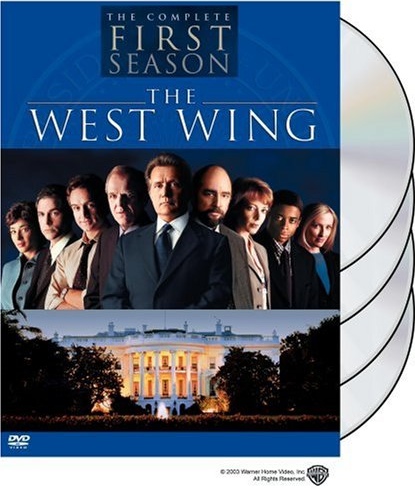
Director: Thomas Schlamme, Chris Misiano
Starring: Jason Ensler, Martin Sheen, Stockard Channing, Allison Janney, Moira Kelly
Genre: Television
Studio: Warner Home Video Theatrical: 1999 Rated:
NR
Languages (Country): English ()
Summary: Conventional wisdom prior to season one of "The West Wing" was that the only successful television shows were half hour sitcoms and hour long police, legal, or medical dramas. Building on surplus ideas from his film "The American President" and the walk-and-talk style of comedy and drama from his critically acclaimed television show "Sports Night", Aaron Sorkin bucked the trend and created his masterpiece, one of the most memorable American political depictions to reach the big or small screen. Season one introduces viewers to a Nobel Prize-winning economist and unabashed intellectual president Jed Bartlet (Martin Sheen) and his key staff members, a newly elected Democratic administration trying to find its footing amidst the corridors of the White House's west wing. To the credit of its cast and their brilliant ensemble acting, "The West Wing" manages to immediately conjure nearly a dozen distinct and memorable characters. Perhaps the greatest star of all is Sorkin's rapid-fire dialogue, especially as delivered by Press Secretary C.J. Craig (Alison Janney), Deputy Chief of Staff Josh Lyman (Bradley Whitford), Deputy Communications Director Sam Seaborn (Rob Lowe), and Chief of Staff Leo McGarry (John Spencer). They carry on conversations while stalking purposefully and unhaltingly down corridors, around corners, and through doorways, and all of it unfurls with the choreographic precision of a classical ballet and the pace of an Olympic ping-pong rally.
What emerges is more than a collective liberal dream of an impassioned administration battling back ultra-conservative bogeymen ranging from the religious right to bigots to gun-toting militants. Wonderful episodes like "The Pilot" and "In Excelsis Deo" portray a government led by heroic, intelligent, and decent men and women. Whether or not one regards that as a political fantasy, it's a remarkably refreshing and appealing vision of politics and its practitioners, one that the public embraced with consistently strong television ratings. In a country whose citizens are used to viewing their elected leaders with mistrust and cynicism, that might be "The West Wing"'s greatest accomplishment. "--Eugene Wei"

Director: Thomas Schlamme, Chris Misiano
Starring: Martin Sheen, Bradley Whitford
Genre: Television
Studio: Warner Home Video Theatrical: 2002 Rated:
NR
Languages (Country): English ()
Summary: The winning streak for this veritable show continues through its fourth year. As with many long-running series, "The West Wing" faces the inevitable--a cast member chooses to leave. But this show handles Rob Lowe's exit with such well-executed grace, a could-be-harmful experience (or at least sudden) is turned into an asset. The season begins with three staff members marooned in the heartland (played mostly for laughs) and ends with a dramatic cliffhanger even more powerful than the initial season's shooting. In between are 20 excellent episodes packed with the series' trademark wit and pace, and an uncannily ability to create excellent moments for the entire cast. The election nears and "West Wing"ers brace for the final onslaught including a make-or-break debate. There's a horrible genocide in Africa changing the course of the Bartlett administration and a covert assassination with effects lingering throughout the season. There's also the now-annual flashback episode, this time to the first days at the White House (with another comforting appearance by Kathryn Joosten as Mrs. Landingham). The series also has its first episode set mostly outside the West Wing when C.J. (Alison Janney) goes back to Ohio for a high school reunion and visits her father (Donald Moffat) who is starting to feel the effects of Alzheimer's.
Lowe's Sam Seaborn picks a new fate at the spur of the moment and is eventually replaced by the very person whose verve he was swept up by--a harried, vastly intelligent campaign manager, Will Bailey (Josh Malina, best known for his work in creator Aaron Sorkin's previous show, "Sports Night"). He's an excellent fit for the West Wing, both fictionally and for the series. Part of the show's success belongs to the continuity, helped immensely by high-caliber guest stars continuing long runs on the show, including Mary-Louise Parker, John Amos, Marlee Matlin, Tim Matheson, Timothy Busfield, Lily Tomlin, Anna Deavere Smith, and Ron Silver (hey, that's a pretty good cast for their "own" show). One-time guest stars are also used to the fullest. Notice how a single-episoe appearance by Christian Slater (as a naval attaché who strikes Donna's fancy) turns into a three-episode arc. Matthew Perry delivers an Emmy-nominated performance in a key role in the season's final arc. This fourth season was capped by the departure of creator-writer Sorkin and producer-director Thomas Schlamme, plus another Emmy win for Best Drama, its fourth straight. Many were surprised or even angered that the series kept up the winning streak. Perhaps the series was not as relevant to the times as four years earlier, but the proof is in the pudding--the series was still in rarefied air by the end of this season.
Luckily, Sorkin and Schlamme were invited to air the commentaries for the DVDs, here on three episodes. It allows them to talk about their departure, a subject barely mentioned in the two making-of featurettes. One deals with speechwriters and other with Stockard Channing's role on the show. Note: the documentaries and deleted scenes are hard to find. Look for the pointer (>) at the bottom right of the special features menu of the sixth disc. "--Doug Thomas"

Director: Thomas Schlamme, Chris Misiano
Starring: Martin Sheen, Bradley Whitford
Genre: Television
Studio: Warner Home Video Theatrical: 2000 Rated:
NR
Languages (Country): English ()
Summary: The second season of "The West Wing" takes up literally where the first season left off and, after a few moments of patriotic sentimentalism, maintains the series' astonishingly high standards in depicting the everyday life of the White House staff of a Democratic administration. The two-part opener covers the immediate aftermath of the assassination attempt on President Bartlet (Martin Sheen), switching between the anxious wait on the injured and flashbacks to Bartlet's campaign for the Presidency. Other peaks in a series exceedingly short on lows include "Noel," the episode in which Alan Arkin's psychiatrist forces Josh Lynam to confront his post-traumatic stress disorder and the episodes in which President Bartlet, following a tragic car accident, rails angrily against God in Latin.
Other new aspects include the introduction of Ainsley Hayes, a young Republican counsel hired after she beats communications deputy Sam Seaborn (Rob Lowe) in a TV debate ("Sam's getting his ass kicked by a girl!" crow his colleagues), as well as the revelation that the President has been suffering from multiple sclerosis. Tensions grow between him and the First Lady (Stockard Channing) as she realizes, in the episode "Third State of the Union," that he intends to run for a second term in office. It becomes clear to Bartlet that he must go public with his MS, and his staff is forced to come to terms with this, as well as deal with the usual plethora of domestic and international incidents, which apparently preclude any of them from having any sort of private lives. These include crises in Haiti and Columbia, an obstinate filibuster, and a Surgeon General's excessively frank remarks about the drug situation. Thankfully, the splendid Lord John Marbury (Roger Rees) is on hand to make chief of staff Leo McGarry's life more of a misery in "The Drop-In."
These episodes, though occasionally marred by a sentimental soundtrack and an earnest and wishfully high regard for the Presidential office, are master classes in drama and dialogue, ranging from the wittily staccato to the magnificently grave, capturing authentically the hectic pace of political intrigue and the often vain efforts of decent, brilliant people to do the right thing. "The West Wing" is one of the all-time great TV dramas. "--David Stubbs"

Director: Thomas Schlamme, Chris Misiano
Starring: Martin Sheen, Bradley Whitford
Genre: Television
Studio: Warner Home Video Theatrical: 2001 Rated:
NR
Languages (Country): English, Spanish ()
Summary: There is no letdown in talent or skill for the third season of this blue ribbon drama. One could say these 22 episodes play as a continuation of the second season; there are no major new characters or earth-shattering plots and the Emmys rewarded the series with its third straight award for Best Drama (and unlike season 4, no one argued about the laurels). The third year starts with a stand-alone episode "Isaac & Ishmael", a special show created, shot, and broadcast 22 days after the 9/11 events. Although the final results tend to be sermonic, the fact the show was able to drop everything and commit to a new season opener is evident not only of talent, but of a disciplined work force operating at the top of their game.
President Bartlet's (Martin Sheen) decision to run for reelection after the disclosure of suffering MS fuels the fire for the first half of the season. Depositions are filed against the staff, minor mistakes take on more significance, and the White House consul (Oliver Platt) has the run of the table warning of worst-case scenarios. The focus soon turns to the First Lady (Stockard Channing) as the potential "Lady Macbeth" of the scandal. Channing aces her role and turns her birthday celebration ("Dead Irish Writers") into one of the season's highlights. Assistant Donna (Janel Moloney), her boss Josh Lyman (Bradley Whitford), and press secretary C.J. (Alison Janney) all have charismatic romances, but the ace supporting player this year is John Spencer as the relentlessly loyal Chief of Staff Leo McGarry. Whether delivering the hard truth, accepting the proverbial bullet for the President, or being our guide to how Bartlet ran in the first place (in another wonderful flashback episode, "Bartlet for America"), all roads lead to McGarry. Acting Emmys went to Channing, Spencer, and Janney, but the strength of this show is that the entire cast has glorious moments (Toby's taking on the President's mode of operation, Sam's belief in government, or the President's peculiarities of Thanksgiving are just a few). Recurring guest stars--the likes of Ron Silver, Tim Matheson, Mary Louise Parker, and Mark Harmon--deliver some of their career-best work. Crack writing, a breathless pace, plus you learn a bit about government. What else do you want from a TV drama? "--Doug Thomas"

